



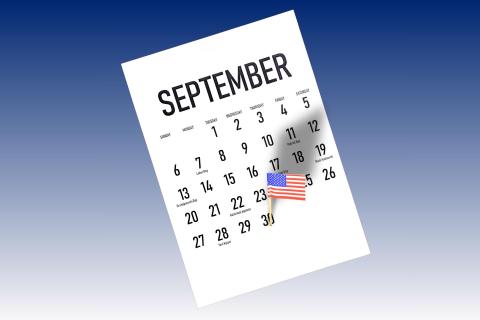
Every September, a familiar idea begins circulating:
The federal government’s fiscal year is ending. Agencies have money left. Nonprofits need to find it—quickly—before it disappears.
It sounds like a clearance sale for federal funding.
But that is a significant oversimplification.
September 30 does matter in federal funding. But it does not mean that federal agencies suddenly open the doors to a room full of unclaimed money and award it to whichever organizations submit a proposal before midnight.
Understanding what the date actually means can help grantseekers prepare more effectively—and avoid chasing opportunities that do not exist.
What is the federal fiscal year?
The federal government’s fiscal year runs from October 1 through September 30.
Fiscal Year 2026, for example, began October 1, 2025, and ends September 30, 2026. Fiscal Year 2027 begins the following day. (USAGov)
The fiscal year provides the accounting period used for federal budgets, spending, obligations, awards, and reporting.
That is why September 30 appears so often in federal documents.
It may be listed as:
- An application deadline
- An anticipated award date
- A project start date
- The end of a budget or project period
- The date by which an agency must obligate certain funds
- The closing date for an annual or continuously open funding opportunity
Those dates do not all mean the same thing.
Current FY2026 listings illustrate the variety. One forecast lists an estimated award date of September 29 and project start date of September 30. Other opportunities remain open through September 30, while some explain that applications received after an earlier internal cutoff may not be funded until the next fiscal year. (Grants.gov)
The date matters. The specific funding announcement matters more.
Is there really a “use it or lose it” rush?
Some federal funding is available only for a defined period, and agencies may face pressure to obligate funds before that period ends.
The Government Accountability Office has acknowledged that a “use-it-or-lose-it” mentality can arise as funds approach the end of their availability. It has also cautioned that increased end-of-year obligations do not automatically indicate waste or careless spending. Timing can be affected by delayed appropriations, continuing resolutions, uncertainty, and other factors. (GAO)
For grantseekers, the important distinction is this:
An agency’s need to complete an award does not necessarily create a new open competition.
The agency may already have:
- Conducted a competitive review
- Selected recommended applicants
- Negotiated budgets
- Made continuation awards
- Allocated formula funding
- Planned amendments to existing awards
- Used another legally authorized process
A nonprofit generally cannot access those funds by sending an unsolicited proposal during the final week of September.
Federal opportunities are governed by eligibility requirements, published procedures, authorizing legislation, appropriations, agency rules, and the terms of the specific notice.
There is no universal September shortcut around those requirements.
Why do so many awards begin around September 30?
An agency may want to make an award or establish an effective date within the fiscal year for which the funding was appropriated.
That is why an applicant might submit a proposal months earlier and receive an award with a late-September effective or project-start date.
The date does not mean the proposal was developed, reviewed, and approved in the final few days of September. In many cases, the public-facing process began much earlier.
That is a useful reminder for nonprofit organizations:
When award announcements appear, the opportunity to compete may already be long over.
Do not confuse the date funding is awarded with the period during which an organization can apply.
What should grantseekers do at the end of September?
Instead of searching for a mythical pot of last-minute money, use the end of the fiscal year to improve your federal funding readiness.
Review your registrations
Organizations applying for federal assistance generally must have an active SAM.gov registration and a Unique Entity ID.
SAM.gov registration must be renewed annually. Grants.gov warns that a new SAM registration can take up to 10 business days to become active when the required information is readily available—and substantially longer when information cannot be validated. An organization cannot begin applying through Grants.gov until its SAM registration is active. (Grants.gov)
Do not discover that your registration has expired when a deadline is five days away.
Confirm:
- Whether the organization’s SAM.gov registration is active
- The renewal date
- Who serves as the Electronic Business Point of Contact
- Who has Grants.gov access
- Who holds the Authorized Organization Representative role
- Whether contact information is current
- Whether more than one staff member understands the system
Review forecasts and subscriptions
Not every federal opportunity appears without warning.
Grants.gov allows users to subscribe to notifications about new and revised opportunities. Forecasts may provide advance notice of anticipated competitions, although dates and details can change. (Grants.gov)
Review the agencies and Assistance Listings most relevant to your work. Look at what they funded previously. Monitor forecasts. Pay attention to recurring programs and typical release periods.
The goal is to identify potential opportunities early enough to make a strategic decision—not simply early enough to start typing.
Study what was funded
Federal award information can help organizations understand which agencies support work like theirs, which organizations have received awards, the size and duration of those awards, and how programs are described.
USAspending.gov allows users to search federal awards by fiscal year, agency, recipient type, location, award type, Assistance Listing, and other criteria. (USAspending)
Obviously, this is not a matter of copying another organization’s program.
It is research that can help your organization better understand the funding landscape.
Strengthen the program before the announcement appears
A federal notice may require detailed work plans, measurable outcomes, organizational capacity, partnerships, data, budgets, assurances, and attachments.
Those elements cannot be developed responsibly in a few frantic days.
If your organization expects to pursue federal funding in the coming year, begin now:
- Clarify the program design.
- Gather current data.
- Talk with the community.
- Develop the evaluation approach.
- Confirm partner roles.
- Build a realistic budget.
- Review compliance requirements.
- Identify who will lead the application.
- Establish internal review and approval procedures.
The most valuable federal-funding preparation often occurs before there is an application on the table.
What happens on October 1?
A new fiscal year begins.
That does not mean every agency immediately releases new opportunities or receives unrestricted access to its full annual budget. Congressional appropriations, continuing resolutions, agency planning, program schedules, and other factors influence when opportunities are announced and when awards can be made.
Grantseekers should watch the funding environment, but they should not build a strategy around one date.
The strongest organizations prepare throughout the year.
They maintain registrations, monitor relevant agencies, study funding patterns, cultivate relationships where appropriate, strengthen programs, and make disciplined decisions about which opportunities to pursue.
September 30 is an important date on the federal calendar.
It is not a magic deadline for finding free money.
And that may be the most useful thing for grantseekers to understand before the annual scramble begins.
The Grantsmanship Center is planning to schedule our Competing for Federal Grants-Online training later this year. If you're interested in attending, please add yourself to our waitlist so that we can be in-touch as we select dates. The federal grants training is an advanced class; please remember to indicate your grant experience when you add your name to the waitlist. Thanks!
Get funding. Create change.